
Postpartum Anxiety: Why You're Scared Something Will Happen to Your Baby or Partner.

3:47 AM. The house is quiet. Too quiet.
You're lying in bed, but your body is on high alert. Your ears aren't tuned to your baby's soft breathing—they're tuned to the silence. You hold your breath. Wait for the next one. When it comes, you exhale. Then the cycle starts again.
This isn't about being a "good enough" mom. This is about whether your baby will survive the night.
Then your mind shifts. Your partner's late coming home. Five minutes becomes ten. Ten becomes catastrophe. You see the accident. The hospital. The funeral. Single motherhood. The life unraveling before it even began.
You tell yourself you're being irrational. Paranoid. But your heart is pounding, and you're already googling another baby monitor, another security camera, another lock—anything to stop the horror movie playing in your mind.
Many women call this paranoia. We call it what it is: Relationship-Centered Perinatal Anxiety—a deep, relational terror focused on the survival of everyone you love. And for many mothers, it didn't start with the baby.
The Anxiety No One Talks About
Here's what most people don't understand: not all postpartum anxiety is created equal.
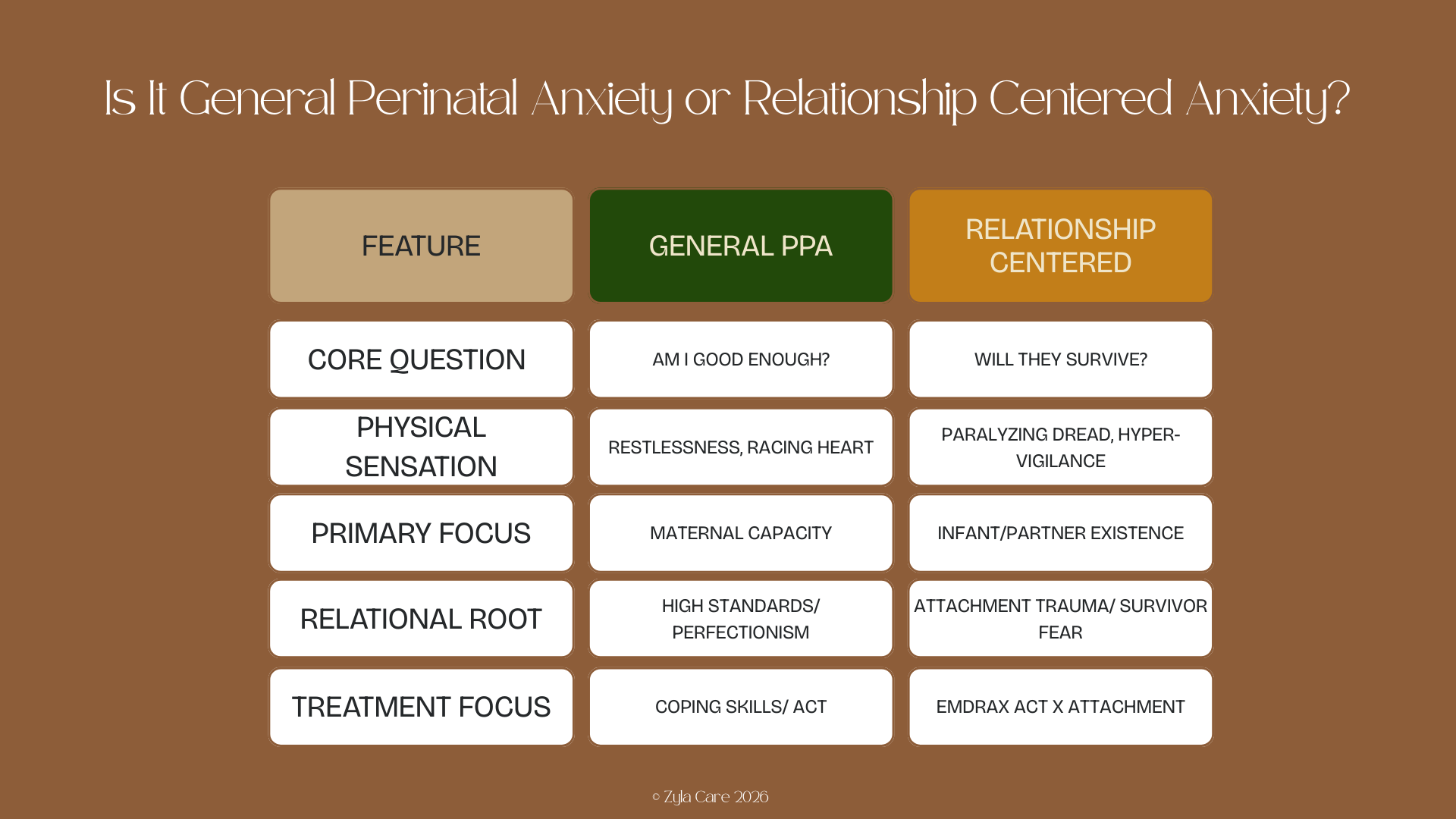
The term "Postpartum Anxiety" (PPA) has become a catch-all, but there's a massive clinical difference between worrying about your performance as a mother and lying awake paralyzed by visions of your family's extinction.
General Perinatal Anxiety asks: "Am I doing this right? What if I can't breastfeed? Will I ever feel like myself again?" It's the anxiety of adequacy—the "What if I fail?" mentality.
Relationship-Centered Anxiety asks something far darker: "What if my baby stops breathing? What if my husband gets in a fatal car crash during his commute? What if I'm left alone with this?"
This isn't about performance. It's about survival.
Research shows that intrusive thoughts about infant death affect up to 70% of new mothers [1], but for some women, these aren't fleeting worries—they're consuming, relentless visions that hijack every quiet moment. When you're stuck in this state, no amount of "positive thinking" or breathing exercises can reach you, because your brain isn't processing anxiety. It's processing terror.

The Truth About Fences and Feelings
You can buy every breathing monitor on Amazon. Install every security camera. Check the GPS every three minutes. But as long as the internal attachment terror remains unaddressed, the fence will never be high enough.
True safety isn't about controlling every variable in the world. It's about a regulated nervous system and secure, healthy attachments.
You Don't Have to Carry This Weight Alone
If you're exhausted from "watching the door," or if your heart lives outside your body, vulnerable and exposed—you deserve more than survival mode. This is our specialty.
What sets our practice apart:
-
Trained specifically in attachment trauma and maternal mental health.
-
We integrate ACT, EMDR, and EFT because research supports layered approaches for layered wounds.
-
We include your baby or partner in sessions when it serves your clinical growth.
Frequently Ask Questions About Relationship Centered Perinatal Anxiety
-
In the postpartum period, your partner represents your "secondary safety attachment." If your history includes unpredictable safety, your brain perceives his absence as a threat to survival.
-
Relational trauma heals through relational connection. By bringing them into sessions, we work on real-time grounding and secure attachment-building.
-
No. Through integrated treatment, your nervous system can return to baseline safety. This is treatable.
-
The Fear: "My anxiety is the only thing keeping my baby safe. If I let my guard down, if I stop checking the monitor every 3 minutes, if I relax even a little—that's when the worst will happen. My vigilance is what's protecting them."
The Reality: Your hypervigilance isn't preventing danger—it's preventing you from being present. Research shows that chronic hypervigilance actually impairs your ability to respond effectively to real threats because your nervous system is constantly depleted. Treatment doesn't make you less aware; it helps you distinguish between real danger and trauma-based false alarms, so you can actually be MORE responsive when it matters.
-
The Fear: "If I'm not constantly terrified, does that mean I don't care enough? What if getting 'better' means I become one of those carefree moms who doesn't take safety seriously? What if I lose the intense love I feel because the intensity of fear goes away?"
The Reality: Love and terror are not the same thing. The goal isn't to make you care less—it's to help you love MORE freely. Treatment doesn't numb you; it allows you to be emotionally present with your baby instead of being trapped in your head catastrophizing. You'll still be protective and attentive, but from a place of grounded connection rather than paralyzed dread.
-
The Fear: "If I admit that I have intrusive thoughts about my baby dying, or that I visualize horrific scenarios, what if my therapist reports me? What if they think I'M the danger? What if CPS gets involved? It's safer to just keep it to myself."
The Reality: Intrusive thoughts about harm coming to your baby (obsessive fears, catastrophic visions) are completely different from thoughts about harming your baby yourself. Mental health professionals who specialize in perinatal care are trained to distinguish between protective anxiety (even when extreme) and actual risk. Catastrophic loss anxiety is about being terrified something will happen TO your baby—not that you'll do something. This is a clinical issue, not a safety concern, and therapists are ethically bound to understand the difference.
-
The Fear: "Maybe I'm being dramatic. Maybe all new moms feel this way and I'm just weak for not handling it better. What if I go to therapy and they tell me this is normal and I should just toughen up? I'll feel stupid for even asking for help."
The Reality: If your anxiety is interfering with sleep, bonding, your relationship, or your quality of life—it's not "just normal new mom worries." Yes, many mothers have intrusive thoughts, but if you're lying awake paralyzed by terror, avoiding situations because of catastrophic fears, or unable to function because you're constantly bracing for loss, that's clinical anxiety. You deserve support, and seeking help isn't weakness—it's courage. A good therapist will validate your experience while helping you heal.
Ready to Stop the “Horror Movie” in your mind?
You didn't choose this terror. But you can choose to heal it. We treat the catastrophic loss anxiety and attachment trauma that keeps new moms from being present with their family.

Written by Abigail Kira LMFT 119629, Founder of Zyla Care.
With a decade of experience of clinical experience, Abigail helps Moms quiet that attachment anxiety that can take over when becoming a new Mom.
-
Fairbrother, N., & Woody, S. R. (2008). Archives of Women's Mental Health.
Seng, J. S., et al. (2013). Journal of Obstetric, Gynecologic & Neonatal Nursing.
Lappalainen, P., et al. (2021). Journal of Contextual Behavioral Science.
Stramrood, C. A., et al. (2012). Birth.
Johnson, S. M., et al. (2019). Clinical Psychology & Psychotherapy.