
Matrescence: What Sacramento Moms Need to Know About Identity After Baby.
Executive Summary: Many mothers moving from the Bay Area back to Sacramento experience a profound identity crisis known as matrescence. This transition is uniquely complicated for those who moved "home" for family support, as they must navigate the tension between their independent professional identities and their roles within their original family structures.

What is Matrescence? Understanding the Identity Shift in New Mothers
In my clinical practice, which serves millennial women across East Sacramento, Land Park, and Midtown, I often hear a specific, haunting sentiment: "I love my baby, but I feel like I’ve completely lost touch with myself." As a clinician, I want you to know that this isn't just "postpartum blues" or "baby brain." This is Matrescence.
Much like adolescence, it is a period of massive hormonal, physical, and social upheaval. However, society expects new mothers to be "glowing" and "grateful." For the millennial mom who just traded a fast-paced life in San Francisco or Oakland for a Sacramento bungalow, this shift feels less like a glow and more like a total system failure. You aren't just learning how to keep a human alive; you are witnessing the death of your former self.
The Expat Dilemma: When Moving "Home" for Family Support Gets Complicated
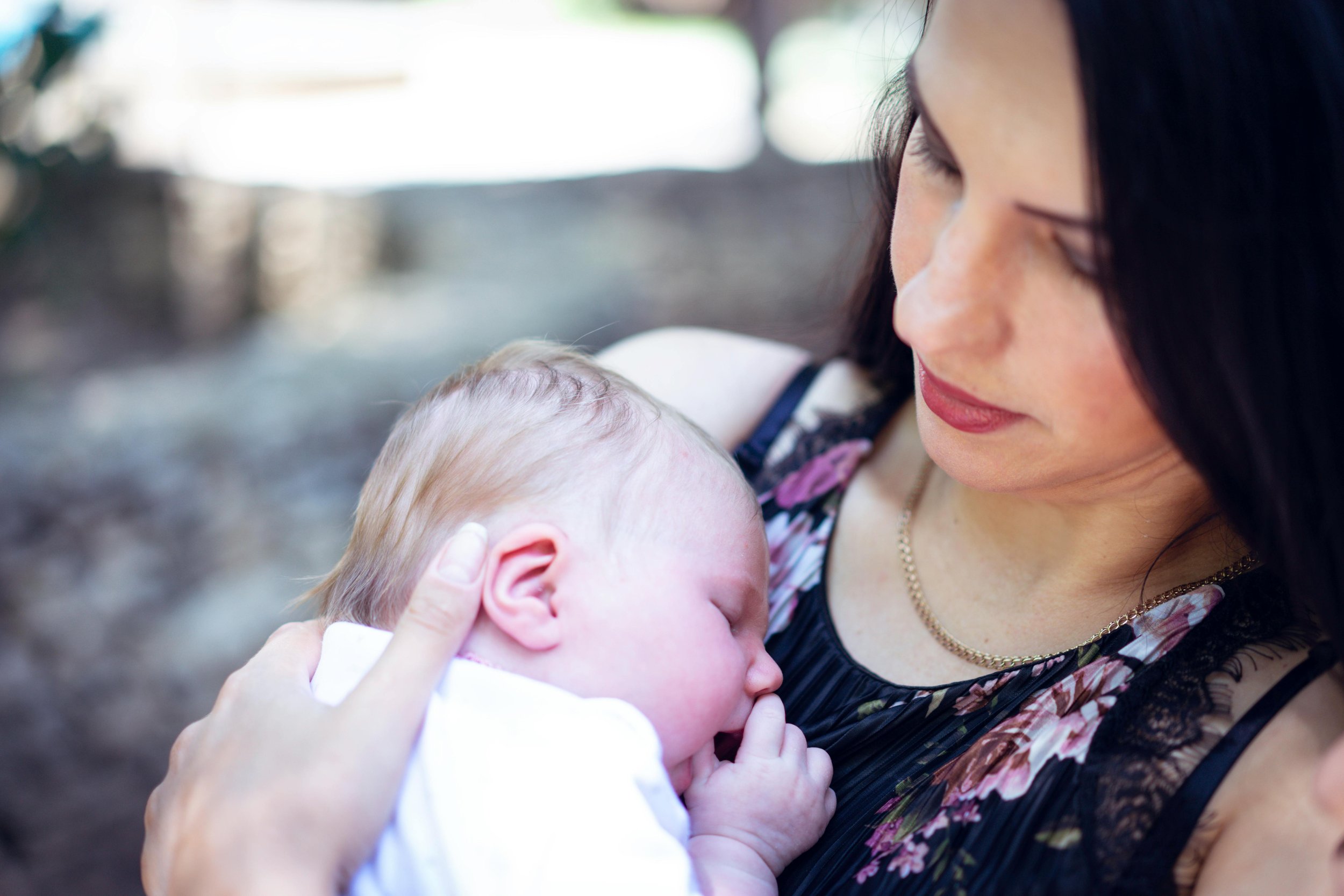
Most of my clients didn't move to Sacramento blindly; they moved here with a plan. You moved to be closer to your parents in Roseville, your siblings in Elk Grove, or your in-laws in Folsom. You traded the isolation of the Bay for the "Village" of the 916.
But as a clinician, I see the hidden shadow of this move: The Identity Regression. In the Bay Area, you were a self-made professional. You were the "Senior Product Manager" or the "Lead Designer." But back in Sacramento, surrounded by your family of origin, you are often pulled back into your old role of "the daughter" or "the little sister." Having your mom over to help with the laundry is a blessing, but it can also be a psychological trigger. When your mother questions your sleep training method or your choice to continue working for a Silicon Valley startup remotely, it creates a "split-screen" identity. You are trying to be a modern, authoritative mother while being treated like the child you were when you left for college.
Why does motherhood feel harder for Bay Area to Sacramento expats?
There is a unique psychological phenomenon occurring in the 916 right now. You might be physically located in Curtis Park or Fair Oaks, but your mind is still in Palo Alto or Mountain View. You log onto Slack with a team that doesn't understand your new reality.
This creates a "liminal space"—the feeling of being in a doorway, neither here nor there. You are no longer the "SOMA power player," but you don't quite feel like the "Sacramento playground mom" either. Even with grandma nearby to watch the baby, the mental dissonance of "who am I now?" remains.
Is "Baby Brain" real? The Science of the Maternal Brain
One of the most common things I hear in my office is: "I used to manage million-dollar budgets, and now I can't remember if I fed the dog." Research by Hoekzema et al. (2017) shows that during pregnancy, the human brain undergoes significant remodeling.
Synaptic Pruning: Much like in puberty, the brain "prunes" certain areas to become more efficient at caregiving.
The Limbic Takeover: Your prefrontal cortex (logic/planning) temporarily yields priority to the limbic system (emotions/attachment).
The Amygdala Shift: Your brain’s smoke detector becomes hyper-activated, making you exquisitely attuned to your baby’s needs.
The Translation: You aren't "losing your edge." Your brain is evolutionarily prioritizing your infant’s survival over your quarterly sales targets. It’s not cognitive decline; it’s cognitive specialization.
The Social Status Overhaul: From "Senior VP" to "Liam's Mom"
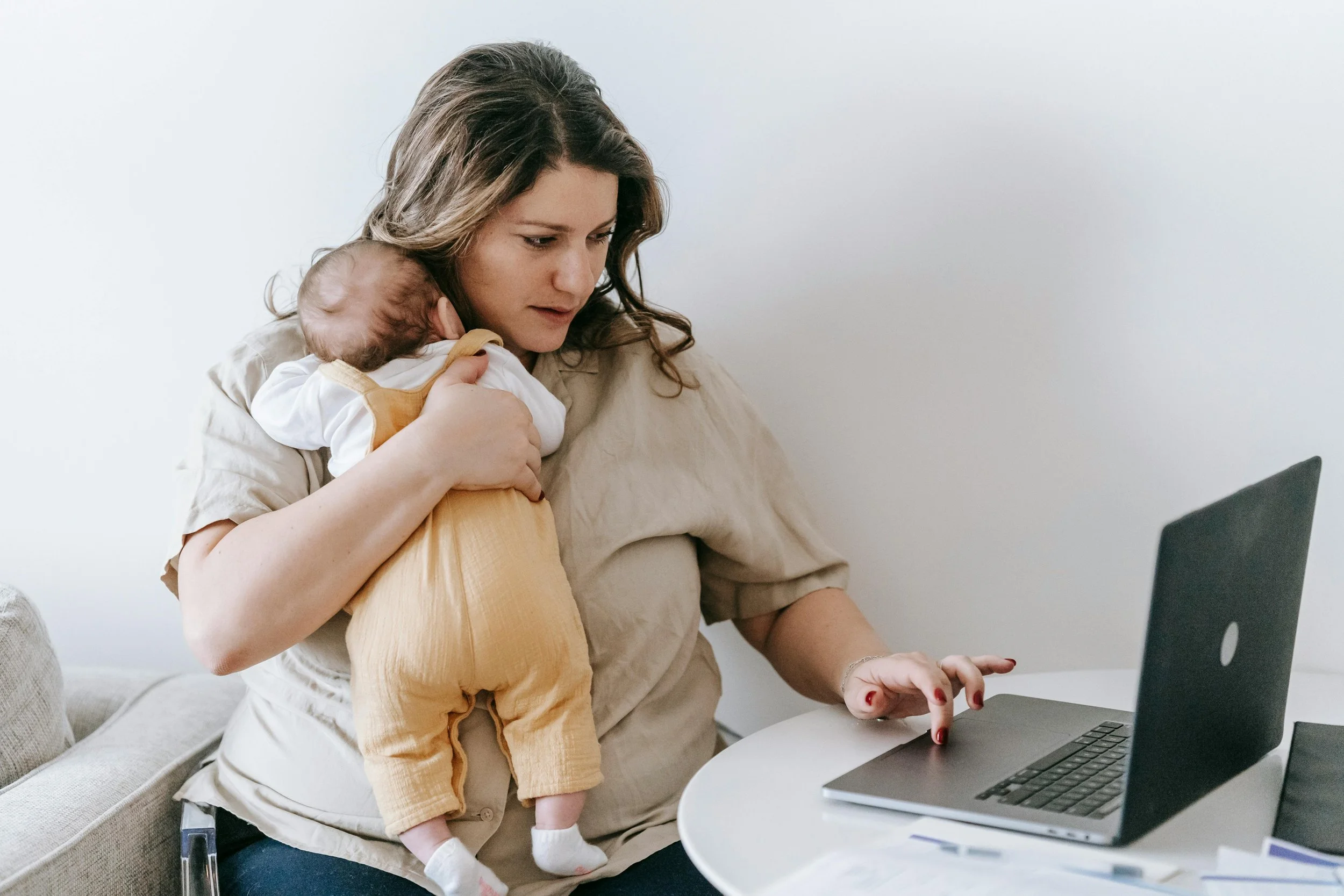
In the Bay Area, your value was likely tied to your output and your intellectual contributions. In the 916, that value system is inverted. Sociologist Shira Offer discusses the "leisure gap," but I often talk to my clients about the "Identity Gap." When you go to a playgroup at McKinley Park, people rarely ask about your career. You become an extension of your child. This is exacerbated when you have family nearby who see you primarily as a mother. The very people who are there to "help" you can sometimes be the ones who most overlook the professional, independent woman you worked so hard to become in your 20s.
Why "Self-Care" Advice Feels Unattainable (Even with Help)
If you’ve read any parenting blog, you’ve seen the advice: "Go to a yoga class in Midtown!" or "Go for a run on the American River Parkway!"
As a clinician, I have to acknowledge: Even with family support, this advice can feel heavy. Many moms feel a "guilt tax" when asking family for help. You might feel you have to "perform" gratitude or that you can't truly relax because you’re worried about grandma’s safety or her ability to follow your baby’s schedule.
The "mental load" doesn't disappear just because your mom is in the kitchen; sometimes, it doubles because you are now managing your child and your family’s expectations. If you feel like you can't even find five minutes to shower despite having a "village," that is not a personal failure. It's the complexity of navigating multi-generational dynamics.
How to Reclaim "You" Via Integration
Since grand gestures are often exhausting, we focus on Integration. These are small, neurological "wins" to help anchor your identity:
-
If your parents are helping with childcare, have a "Professional Hour." This is a time where you are not "Mom" or "Daughter," but your professional self. Even if you aren't working, use this time to read an industry journal at a Temple Coffee or Old Soul location. This physically removes you from the "family of origin" environment and grounds you in your adult identity.
-
Use your time on Hwy 50 or the Capitol Corridor train to listen to a professional development podcast. This keeps your "intellectual self" alive during the transition from the Bay to the 916.
-
Instead of saying "I'm a bad daughter for being annoyed with my mom's help," say "I am experiencing the boundary-blurring of matrescence." Simply naming the shift reduces emotional reactivity in the brain's amygdala.
-
Seek out spaces in Sacramento that acknowledge your dual identity. Look for remote-work hubs in Downtown Sacramento where you can sit among adults and feel like a professional again.
The Sacramento Mom’s Superpower: Integration
The transition from a Bay Area professional to a Sacramento mother is a marathon. You are uniquely positioned to integrate two worlds: the drive of the tech scene with the grounded, community-focused spirit of the 916.
In my practice, I don't help moms "get their old lives back." I help them build a new, integrated identity that honors the woman they were in San Francisco and the mother they are becoming in Sacramento.
You are not broken. You are in transition. And just as we don’t expect a teenager to navigate puberty in a weekend, you shouldn't expect yourself to "master" motherhood without a massive internal upheaval. Be gentle with yourself. You are doing the hard work of becoming.
Your identity shouldn't feel like an outdated OS. If you’re balancing a Bay Area career with a Sacramento zip code—and a newborn—the mental load can be staggering. We provide the specialized support tech-forward moms need to recalibrate during the transition to motherhood. Let’s get your "self" back online.
Written by Sarah Patterson AMFT 152544 and perinatal specialist at Zyla Care.
Sarah is passionate about helping Sacramento New Moms process the identity shift into Motherhood.
FAQ: Common Questions About Matrescence & Identity
-
A: Depending on your family member you have two options. If they are open and genuinely curious to understand you, lovingly explain. Use the term Matrescence. Explain that just like adolescence, this is a biological and developmental stage. It’s not a "mood"; it’s a transition. Sharing the science—like the brain remodeling—can help family members understand that your experience is grounded in biology. However, if the family member is stuck in hyper criticism or historically hasn’t shown greater understanding after an explanation is offered, simply redirect the conversation.
-
No. Matrescence is a normal developmental stage. PPD is a clinical mood disorder. However, a difficult matrescence—especially one marked by the pressure of family expectations—can be a risk factor for PPD that’s why it’s important to get the support in this transition into Motherhood. If you’re a first time, working Mom, just starting to go back to work, please schedule a free consultation.
-
Athan, A., & Reel, H. L. (2015). Maternal psychology: Reflections on the 20th anniversary of Motherhood and Mental Health by Jane Honikman and the postpartum support movement. Journal of the Motherhood Initiative, 6(1), 239-250.
Gavin, N. I., Gaynes, B. N., Lohr, K. N., Meltzer-Brody, S., Gartlehner, G., & Swinson, T. (2015). Perinatal depression: A systematic review of prevalence and incidence. Obstetrics & Gynecology, 106(5), 1071-1083.
Gunderson, E. P., Quesenberry Jr, C. P., Jacobs Jr, D. R., Feng, J., Lewis, C. E., & Sidney, S. (2018). Longitudinal study of prepregnancy cardiometabolic risk factors and subsequent risk of gestational diabetes mellitus. Diabetes Care, 41(12), 2458-2465.
Hoekzema, E., Barba-Müller, E., Pozzobon, C., Picado, M., Lucco, F., García-García, D., Soliva, J. C., Tobeña, A., Desco, M., Crone, E. A., Ballesteros, A., Carmona, S., & Vilarroya, O. (2017). Pregnancy leads to long-lasting changes in human brain structure. Nature Neuroscience, 20(2), 287-296.
Kim, P., Leckman, J. F., Mayes, L. C., Feldman, R., Wang, X., & Swain, J. E. (2010). The plasticity of human maternal brain: Longitudinal changes in brain anatomy during the early postpartum period. Behavioral Neuroscience, 124(5), 695-700.
Lieberman, M. D., Eisenberger, N. I., Crockett, M. J., Tom, S. M., Pfeifer, J. H., & Way, B. M. (2007). Putting feelings into words: Affect labeling disrupts amygdala activity in response to affective stimuli. Psychological Science, 18(5), 421-428.
Molgora, S., Fenaroli, V., Prino, L. E., Rollè, L., Sechi, C., Trovato, A., Vismara, L., Volpi, B., Saita, E., & Tambelli, R. (2018). Fear of childbirth in primiparous Italian pregnant women: The role of anxiety, depression, and couple adjustment. Women & Health, 58(4), 453-469.
Offer, S. (2014). Time with children and employed parents’ emotional well-being. Social Science Research, 47, 192-203.
Prikhidko, A., & Swank, J. M. (2020). Exhausted parents: Sociodemographic factors related to parenting stress during COVID-19 in the United States. Journal of Family Issues, 41(11), 2089-2106.
Raphael, D. (1973). The Tender Gift: Breastfeeding. Prentice-Hall.
Sacks, A. (2017). A new way to think about the transition to motherhood. TED Talk, TEDWomen.
Stadlen, N. (2004). What Mothers Do: Especially When It Looks Like Nothing. Piatkus Books.
Swain, J. E., Kim, P., Spicer, J., Ho, S. S., Dayton, C. J., Elmadih, A., & Abel, K. M. (2014). Approaching the biology of human parental attachment: Brain imaging, oxytocin and coordinated assessments of mothers and fathers. Brain Research, 1580, 78-101.